Black holes, the mysterious cosmic entities with gravitational forces so powerful that not even light can escape, continue to perplex scientists and push the boundaries of our understanding of the universe. While much has been discovered and confirmed about black holes, there are still theories yet unproved that delve into the intricate relationship between time and these enigmatic objects.
Time Dilation Near Black Holes:
One of the theories that remains unproved but holds immense potential is the concept of time dilation near black holes. Massive black holes are thought to warp the fabric of spacetime, causing time to pass differently depending on the strength of gravity experienced. This phenomenon, known as gravitational time dilation, suggests that time slows down in the presence of strong gravitational fields.
Near the event horizon of a black hole, where gravity is extraordinarily intense, time dilation is believed to become even more pronounced. As an observer approaches the event horizon, time for them appears to slow down compared to an observer far away from the black hole. This implies that an object falling into a black hole may experience time passing much more slowly compared to an outside observer. However, due to the extreme conditions near black holes, this theory remains unproved and requires further exploration and evidence.

Black Holes and Time Travel:
The mind-bending nature of black holes has sparked speculation about their potential connection to time travel. The concept of using black holes as portals for traversing through time has been a subject of fascination in science fiction. However, in the realm of scientific theory, the possibility of black holes enabling time travel is still purely speculative and lacks empirical evidence.
According to certain theories, if a stable traversable wormhole were to exist within or near a black hole, it could potentially provide a shortcut through spacetime, enabling a form of time travel. These theories often involve complex notions like negative energy and exotic matter to stabilize the wormhole and maintain its viability for human passage.

Paradoxes and the Information Paradox:
Another intriguing aspect of black holes that has given rise to theoretical speculation is the concept of paradoxes. The most notable of these is the information paradox. According to classical physics, once matter crosses the event horizon of a black hole, it is believed to be lost forever, leading to the question of what happens to the information contained within that matter.
Quantum mechanics, however, suggests that information is never truly lost but instead preserved in the fabric of spacetime. This discrepancy has given rise to the information paradox, which challenges our understanding of fundamental principles such as the conservation of information.
Several theories and hypotheses, including the holographic principle and the firewall paradox, attempt to reconcile this conflict and shed light on the fate of information that enters a black hole. However, a conclusive resolution to the information paradox remains elusive, and further research and exploration are necessary to unravel this enigma.
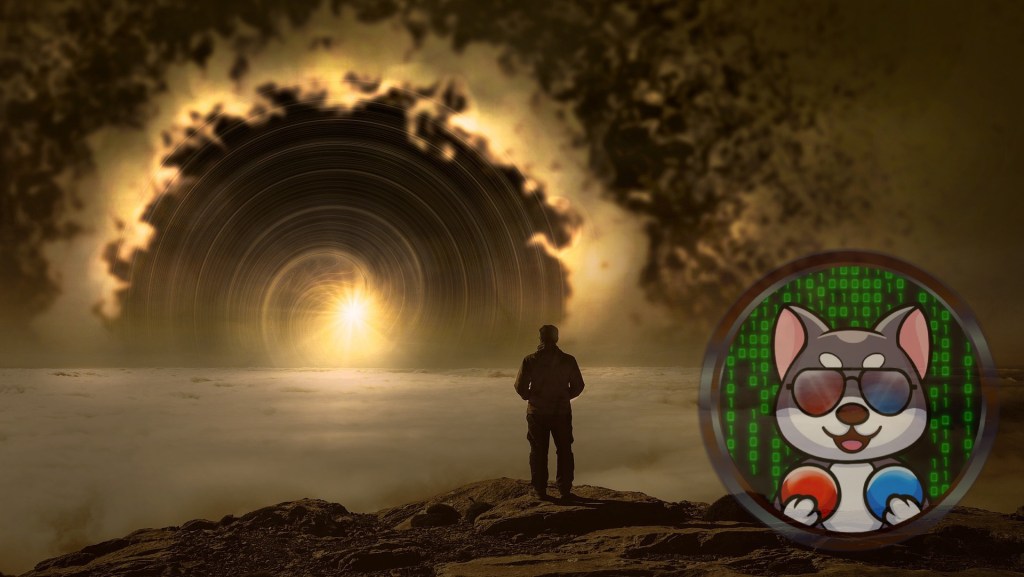
Black holes continue to be a source of fascination and a playground for theoretical speculation. The unproved theories surrounding time dilation, black holes as potential portals for time travel, and the information paradox highlight the cutting-edge questions in modern astrophysics. As our knowledge and technological capabilities advance, we may uncover new insights and evidence that shed light on the intricate relationship between black holes and the nature of time, ultimately deepening our understanding of the universe.

 Microcap and Nanocap Crypto