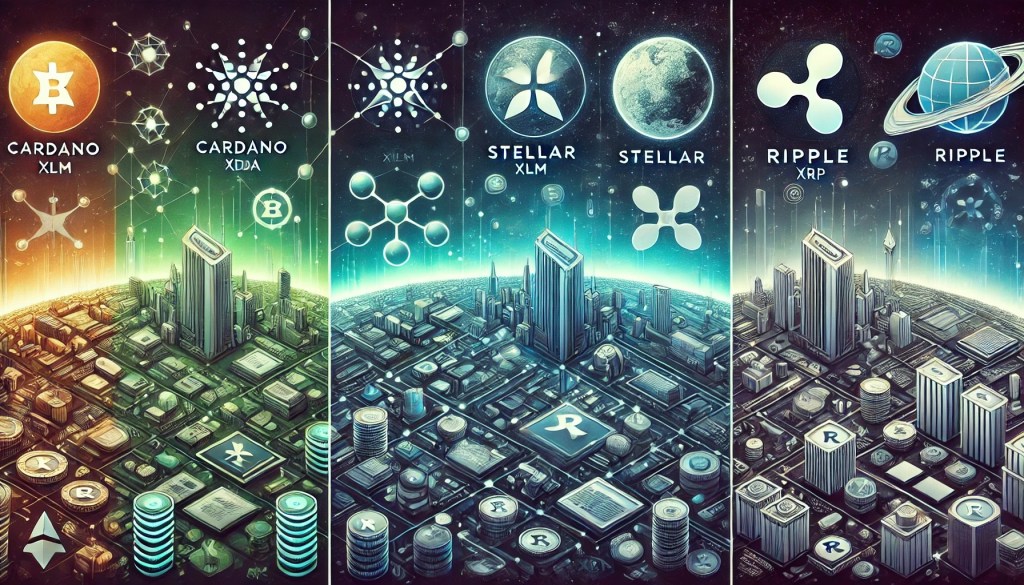
Cardano ($ADA) and Stellar ($XLM) are both strong contenders in the cryptocurrency space, and each brings unique features and value propositions. How do they measure up compared to $XRP in key areas like decentralization, scalability, adoption, and innovation?
1. Decentralization
• Cardano ($ADA):
• Cardano is known for its commitment to decentralization. With its Ouroboros proof-of-stake (PoS) protocol, Cardano ensures security and decentralization while reducing energy consumption.
• The network has a large number of stake pools (~3,200 as of 2024), making it more decentralized than $XRP.
• Advantage: Cardano leads in decentralization, aligning well with crypto’s foundational ethos.
• Stellar ($XLM):
• Stellar uses the Stellar Consensus Protocol (SCP), which relies on a federated byzantine agreement (FBA). While this method is efficient, it can be perceived as more centralized compared to fully decentralized PoS systems like Cardano.
• Stellar is still more decentralized than Ripple’s $XRP, as it doesn’t concentrate control in one company like Ripple Labs does for $XRP.
• Advantage: Stellar is decentralized but not as much as Cardano.
2. Scalability and Transaction Speed
• Cardano ($ADA):
• Cardano is designed for scalability through Hydra, its layer-2 scaling solution. Once fully deployed, Hydra could handle up to 1 million transactions per second (TPS).
• However, current throughput is limited (~250 TPS in real-world scenarios) and still developing.
• Advantage: High potential, but scalability is still a work in progress.
• Stellar ($XLM):
• Stellar processes transactions much faster, with ~1,000 TPS and a confirmation time of 3-5 seconds. This is comparable to $XRP and significantly faster than Cardano in its current state.
• Stellar’s system is built specifically for cross-border payments, excelling in speed and efficiency.
• Advantage: Stellar currently outperforms Cardano in transaction speed.
3. Adoption and Use Cases
• Cardano ($ADA):
• Focuses on long-term adoption through academic rigor and strong partnerships in developing regions (e.g., Ethiopia’s education system).
• It is a general-purpose blockchain for DeFi, NFTs, and more, with growing adoption but still trailing behind $XRP and $XLM in payment-focused use cases.
• Advantage: Broad and diverse use cases beyond payments, including smart contracts.
• Stellar ($XLM):
• Stellar focuses on cross-border payments and remittances, with notable partnerships like IBM’s World Wire and integrations with global remittance companies.
• It has carved a niche in financial inclusion, particularly in regions with unbanked populations.
• Advantage: Stellar excels in its specific niche of payments and remittances.
4. Regulatory Position
• Cardano ($ADA):
• Cardano has maintained a neutral stance on regulatory issues, emphasizing compliance without being overly tied to centralized entities.
• Its emphasis on decentralization may shield it from regulatory scrutiny, unlike $XRP, which has faced legal challenges.
• Advantage: Likely to face fewer regulatory hurdles than $XRP.
• Stellar ($XLM):
• Stellar has a cooperative approach with regulators and financial institutions, positioning itself as a bridge between traditional and decentralized systems.
• While not immune to regulatory concerns, it has avoided the high-profile scrutiny faced by Ripple and $XRP.
• Advantage: Strong regulatory positioning due to partnerships with financial institutions.
5. Energy Efficiency
• Cardano ($ADA):
• Cardano’s PoS protocol is highly energy-efficient compared to older proof-of-work (PoW) systems, making it an eco-friendly choice.
• Advantage: A leader in energy efficiency.
• Stellar ($XLM):
• Stellar’s FBA protocol is lightweight and energy-efficient, rivaling Cardano in sustainability.
• Advantage: Comparable to Cardano in energy efficiency.
6. Community and Ecosystem
• Cardano ($ADA):
• Cardano has a robust and dedicated community, often referred to as one of the most passionate in the crypto space. Its ecosystem is growing, with DeFi platforms, NFT projects, and more.
• Advantage: Strong ecosystem growth and active community support.
• Stellar ($XLM):
• Stellar’s community is focused primarily on financial services and cross-border payments. While active, its ecosystem is narrower in scope compared to Cardano.
• Advantage: Strong but specialized community.
Head-to-Head Comparison
Feature $ADA (Cardano) $XLM (Stellar) $XRP
Decentralization High Moderate Low
Transaction Speed Moderate (Potential: High) High High
Scalability High (Potential: Hydra) High High
Adoption Broad (DeFi, NFTs, etc.) Focused (Payments & Remittances) Payments (Institutional Focus)
Regulatory Position Strong Strong Uncertain
Energy Efficiency High High Moderate
Conclusion: Which Measures Up Better?
• Cardano ($ADA): Best for users looking for a long-term investment in a highly decentralized and versatile blockchain. Its broad use cases and scalability potential make it a strong choice for general-purpose applications.
• Stellar ($XLM): Ideal for those focused on fast and efficient cross-border payments. Its partnerships and payment-specific features make it a strong alternative to $XRP in this niche.
While $XRP still holds value in institutional payment networks, both $ADA and $XLM address key criticisms of $XRP, offering more decentralized and sustainable solutions with growing adoption.
- Top Low-Cap RWATop Low-Cap RWA Crypto Tokens to Watch in 2026 The Real World Assets (RWA) narrative is rapidly becoming one of the most important sectors in crypto. As institutions like BlackRock push tokenization forward, smaller-cap projects are positioning themselves to capture massive upside. While larger players like POLYX, ONDO, and CFG dominate headlines, a new wave… Read more: Top Low-Cap RWA
- Top 15 RWA tokensThe 15 RWA Tokens Most Mentioned on X in the Last 30 Days — Signals for the Next Tokenization Wave In crypto markets, attention often moves before capital. One of the clearest places to observe emerging narratives is X (formerly Twitter), where traders, developers, venture funds, and researchers constantly debate which sectors are gaining momentum.… Read more: Top 15 RWA tokens
- Trending Crypto TokensTrending Crypto Tokens Today: AI, Privacy, RWA and DeFi Narratives Heating Up The cryptocurrency market constantly evolves as new narratives emerge and capital rotates between sectors. Today’s trending tokens highlight several powerful themes shaping the next phase of the crypto cycle, including decentralized AI infrastructure, privacy technology, real-world asset tokenization, and blockchain trading infrastructure. Below… Read more: Trending Crypto Tokens
- Stablecoin Yield WarsStablecoin Yield Wars: Why Banks and Crypto Are Colliding A new financial battle is quietly unfolding between traditional banks and the crypto industry, and it centers on a surprisingly simple question: Should stablecoins be allowed to pay yield? Recent political messaging from Eric Trump and statements aligned with Donald Trump highlight growing tension around this… Read more: Stablecoin Yield Wars
- Which Altcoins Will Survive the Next Cycle?Crypto history is brutal. Thousands of tokens launch during every bull market. Many capture attention for a few months. Some explode in price. A handful dominate headlines. But only a small number survive multiple cycles. If you look back through crypto’s short but dramatic history, the pattern is clear: hype is temporary, infrastructure is durable.… Read more: Which Altcoins Will Survive the Next Cycle?

 Microcap and Nanocap Crypto