Why $GPU (NodeAI) May Be the Most Underrated AI Token of 2025
As AI continues to reshape the digital economy, one thing becomes increasingly clear: compute is king. While many AI tokens focus on vision, speculation, or vague infrastructure promises, $GPU, the token powering NodeAI, is quietly carving out a space in the market with real, tangible utility.
NodeAI is a decentralized platform designed to provide access to GPU resources for AI development. It allows users to rent GPU-rich servers, lend out unused hardware, and earn passive income through staking. Backed by blockchain, it operates transparently and distributes rewards fairly, aligning with the ideals of decentralized infrastructure and financial inclusion.
The Real Infrastructure Play
What sets $GPU apart from most other AI tokens is that it actually supports real-world computing tasks. From GPU mining and AI workload execution to the integration of decentralized physical infrastructure networks (DePIN), NodeAI isn’t just a concept—it’s a functioning ecosystem.
Users can deploy AI models, train machine learning systems, or run inference tasks, all through decentralized nodes powered by contributors’ GPUs. This model creates a circular economy where GPU owners earn $GPU for lending their power, while developers get access to high-performance hardware without relying on centralized cloud giants like AWS or Google Cloud.
Even more compelling: users who stake $GPU can earn rewards not only in the token itself but also in Ethereum (ETH), adding another layer of incentive to long-term participation.
As of May 13, 2025, $GPU is trading around $0.4956, with a 7.2% increase over 24 hours, a market cap of approximately $48 million, and over 97 million tokens in circulation. While still significantly below its all-time high of $2.85 (set in April 2024), the token has rebounded sharply from lows earlier this year—indicating a resurgence in both retail and institutional interest.

How Does $GPU Compare to Other Top AI Tokens?
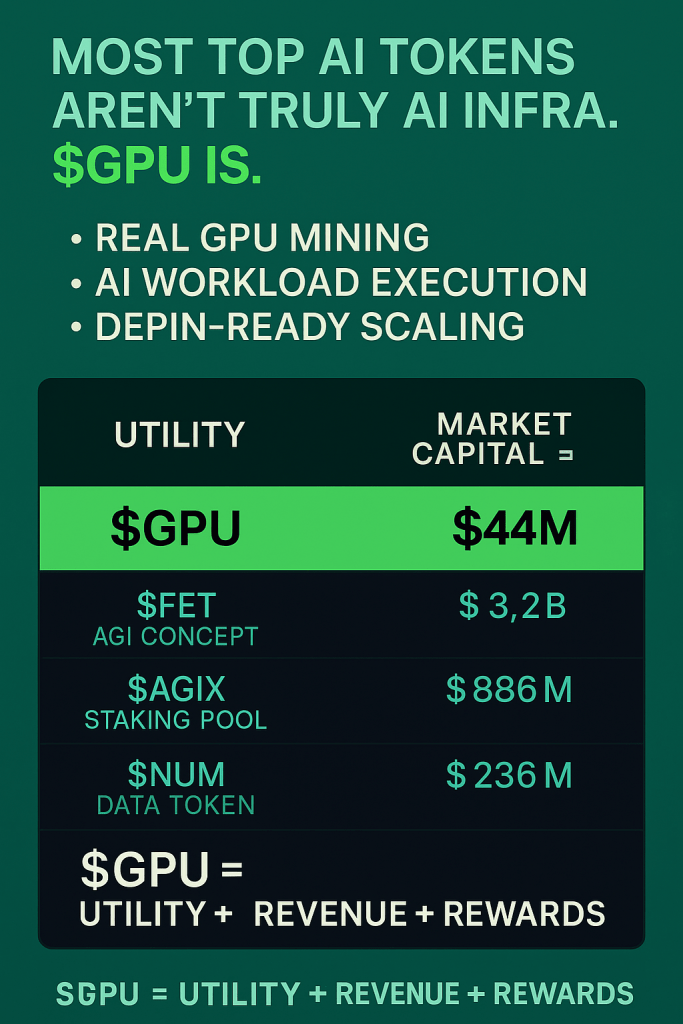
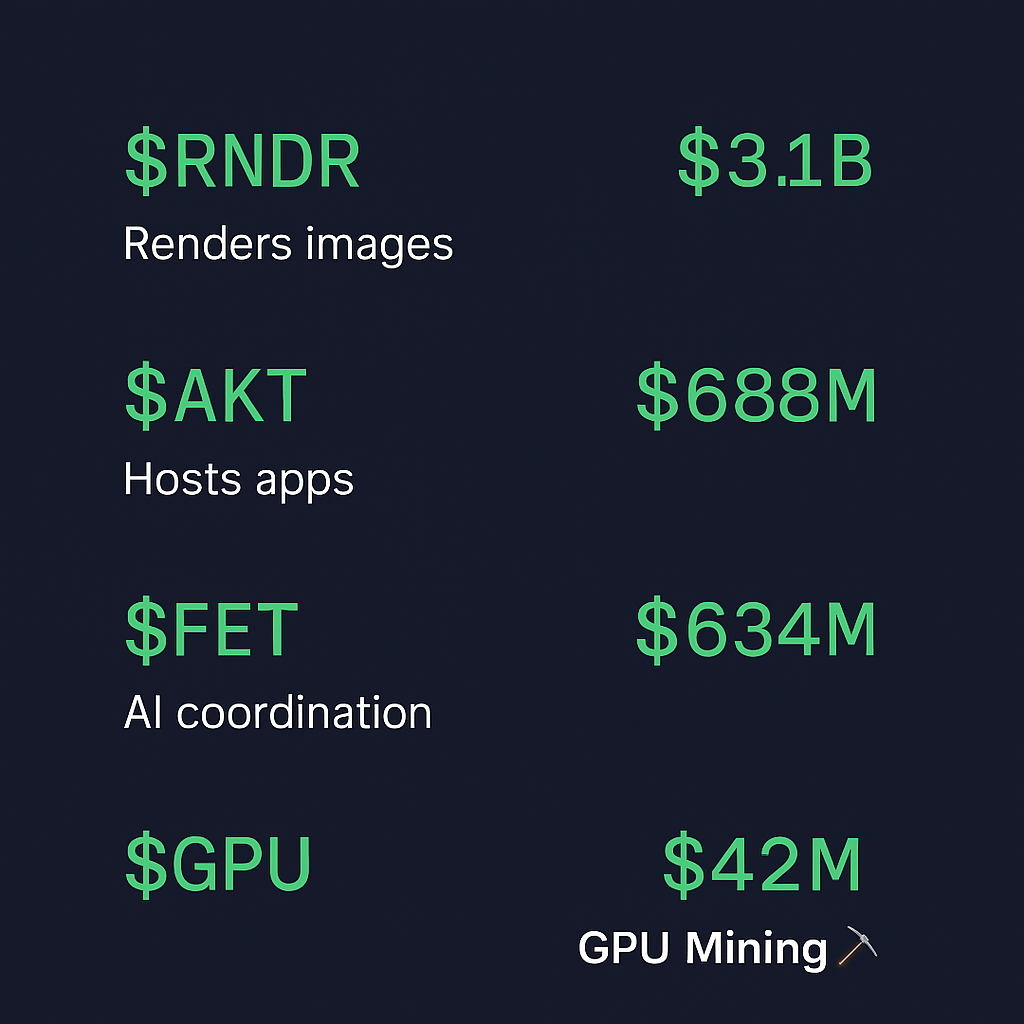
To understand why $GPU may be undervalued, it helps to look at how it stacks up against well-known tokens like $AKT (Akash Network) and $FET (Fetch.ai)—both with market caps in the billion-dollar range.
$AKT: Decentralized Hosting, Not Compute
Akash Network is often seen as a cornerstone of decentralized cloud infrastructure. It allows developers to rent unused computing resources through a permissionless marketplace. However, its focus is more on general hosting than AI-specific workloads. While $AKT supports containers and scalable infrastructure, it lacks the direct GPU mining and AI execution capabilities that define $GPU’s core utility.
In contrast, NodeAI is built from the ground up to support GPU-powered AI tasks, making it highly specialized and aligned with the surging demand for AI compute—particularly in areas like large language models (LLMs), image generation, and video analytics.
Where $AKT decentralizes compute hosting, $GPU decentralizes AI compute itself. The difference is critical: $GPU is not merely infrastructure for running apps—it’s the engine behind actual AI processing.
$FET: AI Agents and Coordination Layers
Fetch.ai ($FET) is another heavyweight in the AI token space. Its primary focus is on autonomous agent communication and coordination—essentially, teaching AI agents to interact and transact on their own. It’s an ambitious project, and one that could be vital for Web3 automation in the future.
But $FET isn’t offering real compute. It’s not focused on providing GPU power or supporting heavy model training. Instead, it aims to optimize data sharing and decision-making between agents. This is powerful in theory, but $GPU addresses a more immediate, physical bottleneck: the shortage of affordable, accessible GPU power for real-time AI workloads.
In other words, while $FET is trying to build a layer for AI-to-AI communication, $GPU is laying down the foundation AI actually needs to run.
Why $GPU Matters Now
What makes $GPU compelling isn’t just its utility—it’s the timing.
AI is no longer an emerging trend. It’s the infrastructure powering finance, biotech, logistics, gaming, and defense. The ability to train models, process visual data, or deploy intelligent assistants all comes down to access to GPUs. And that access is increasingly expensive and centralized.
NodeAI offers an alternative: plug in, get rewarded, and contribute to something bigger than a single chain or application. Whether you’re a hardware owner earning passive income or a developer looking to avoid cloud lock-in, $GPU offers a path forward.
And with under $50M in market cap and most competitors already trading 10x–70x higher, the upside is hard to ignore.
Conclusion
In a sea of speculative AI tokens, $GPU stands out as one of the few with true infrastructure backing. It’s not promising the future—it’s powering it.
Whether it ultimately becomes the Filecoin of GPU compute or simply secures a major slice of the decentralized AI economy, one thing is clear: $GPU deserves a closer look.
Visit nodes.ai to learn more.
- Top Low-Cap RWA
 Top Low-Cap RWA Crypto Tokens to Watch in 2026 The Real World Assets (RWA) narrative is rapidly becoming one of the most important sectors in crypto. As institutions like BlackRock push tokenization forward, smaller-cap projects are positioning themselves to capture massive upside. While larger players like POLYX, ONDO, and CFG dominate headlines, a new wave… Read more: Top Low-Cap RWA
 - Top 15 RWA tokens
 The 15 RWA Tokens Most Mentioned on X in the Last 30 Days — Signals for the Next Tokenization Wave In crypto markets, attention often moves before capital. One of the clearest places to observe emerging narratives is X (formerly Twitter), where traders, developers, venture funds, and researchers constantly debate which sectors are gaining momentum.… Read more: Top 15 RWA tokens
 - Trending Crypto Tokens
 Trending Crypto Tokens Today: AI, Privacy, RWA and DeFi Narratives Heating Up The cryptocurrency market constantly evolves as new narratives emerge and capital rotates between sectors. Today’s trending tokens highlight several powerful themes shaping the next phase of the crypto cycle, including decentralized AI infrastructure, privacy technology, real-world asset tokenization, and blockchain trading infrastructure. Below… Read more: Trending Crypto Tokens
 - Stablecoin Yield Wars
 Stablecoin Yield Wars: Why Banks and Crypto Are Colliding A new financial battle is quietly unfolding between traditional banks and the crypto industry, and it centers on a surprisingly simple question: Should stablecoins be allowed to pay yield? Recent political messaging from Eric Trump and statements aligned with Donald Trump highlight growing tension around this… Read more: Stablecoin Yield Wars
 - Which Altcoins Will Survive the Next Cycle?
 Crypto history is brutal. Thousands of tokens launch during every bull market. Many capture attention for a few months. Some explode in price. A handful dominate headlines. But only a small number survive multiple cycles. If you look back through crypto’s short but dramatic history, the pattern is clear: hype is temporary, infrastructure is durable.… Read more: Which Altcoins Will Survive the Next Cycle?
 - Top 8 Altcoins 2026
 Top 8 Altcoins to Watch in 2026 2026 has opened with a shift in tone. After extended consolidation and selective liquidity, capital is rotating again — not everywhere, but into ecosystems with structure, distribution, and product-market fit. This isn’t a blind altseason thesis. It’s a targeted positioning phase. Here are eight altcoins worth watching this… Read more: Top 8 Altcoins 2026
 - The New Trending TokensThe New Trending Tokens of 2026: Where Momentum Is Building Markets don’t move randomly. 2026 has started with a different tone. After months of hesitation and liquidity compression, markets are beginning to ask the real question: is this finally the rebound phase? As macro pressure stabilizes and capital rotates back into risk, select altcoins are… Read more: The New Trending Tokens
- The Return of the Altcoins
 The Return of the Altcoins March 2026 feels different. After a brutal 2025 of shakeouts, liquidations, and regulatory recalibration, capital is rotating back into risk. Inflation is cooling. Rate cuts are back on the table. Liquidity is thawing. And when liquidity flows, altcoins move fast. Bitcoin still sets the tone. But altcoins are starting to… Read more: The Return of the Altcoins
 - New Millionaire Games
 EvoJacks Launches New Millionaire Games With Free Testing Weekend EvoJacks.com is entering a new phase. Later this week, the platform will roll out a brand-new suite of Millionaire Games, all built fully in-house and designed around a single, bold idea: familiar casino formats, re-engineered for extreme upside. At the center of the upcoming launch is… Read more: New Millionaire Games

 Microcap and Nanocap Crypto