Europe’s Boom Towns: The Secondary Cities Quietly Winning 2025–2026
For years, Europe’s biggest capitals dominated attention. London, Paris, Berlin, and Amsterdam absorbed talent, startups, and investment while smaller cities played supporting roles.
That balance is starting to shift.
Across Europe, a new generation of “boom towns” is emerging — cities combining affordability, livability, startup growth, migration appeal, and long-term economic momentum. Unlike traditional boomtown stories built around suburban sprawl or speculation, Europe’s rising cities are often historic, walkable, university-driven, and deeply connected to regional infrastructure.
The real story of Europe in 2025–2026 may not be the capitals anymore. It may be the secondary cities.
The New European Growth Formula
Several major trends are converging at once.
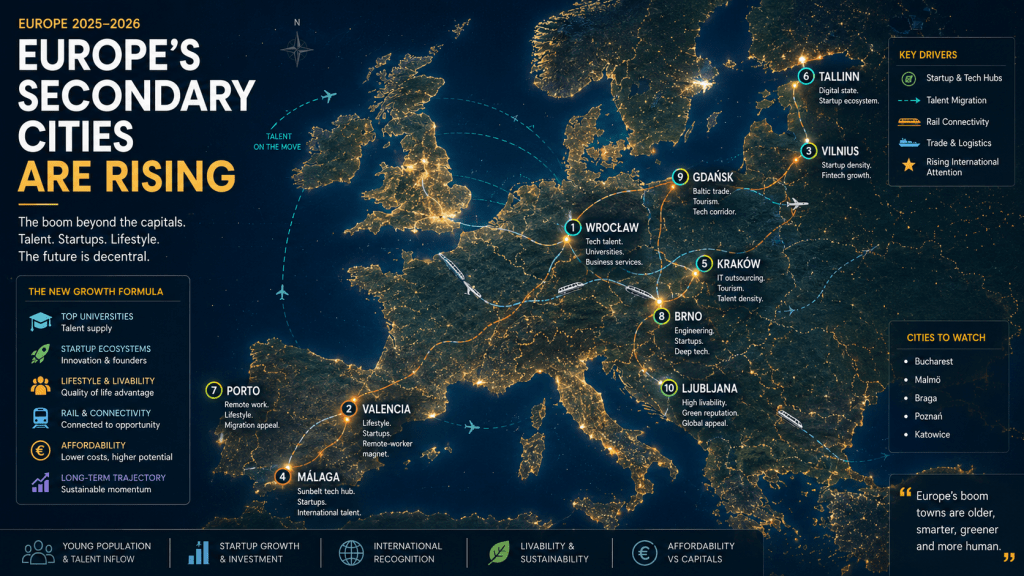
Remote work has weakened the monopoly of expensive capitals. Startup ecosystems are spreading outward. International talent increasingly prioritizes climate, quality of life, safety, and affordability. Meanwhile, rail infrastructure and digital connectivity make it easier than ever to build companies outside traditional power centers.
This has created a new category of city:
high-skill, internationally connected, but still relatively affordable.
In many ways, Europe’s emerging boom towns are becoming the continent’s new economic middle layer — balancing opportunity, lifestyle, and resilience more effectively than some overstretched capitals.
Poland’s Quiet Dominance
One of the clearest patterns is Poland’s rise as Europe’s strongest secondary-city growth engine.
Cities like Wrocław, Kraków, and Gdańsk combine strong universities, growing tech sectors, expanding business-service industries, manufacturing strength, and increasing international investment.
Wrocław arguably stands out most. It has become one of Europe’s clearest examples of a modern secondary-city success story: highly educated workforce, strong engineering talent, rising startup activity, and significantly lower costs than Western European capitals.
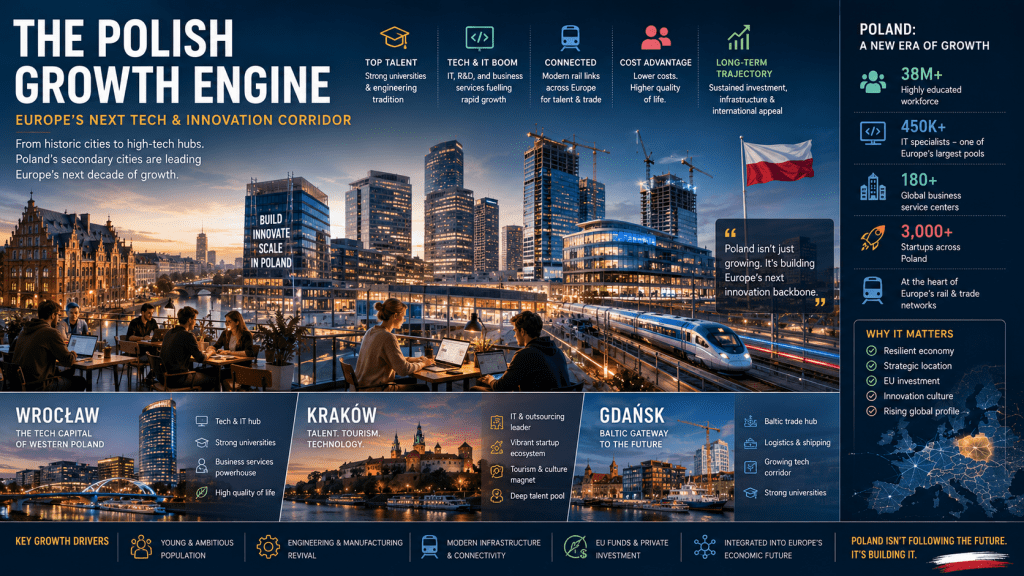
Kraków continues benefiting from tourism, IT outsourcing, and international business expansion, while Gdańsk increasingly leverages its Baltic trade position, logistics infrastructure, and growing tech corridor.
Rather than relying on hype, many Polish cities are benefiting from steady structural advantages:
education, logistics, infrastructure, talent density, and geographic positioning within Europe’s evolving economy.
Southern Europe’s Lifestyle-Tech Explosion
At the same time, Southern Europe is experiencing a different kind of boom.
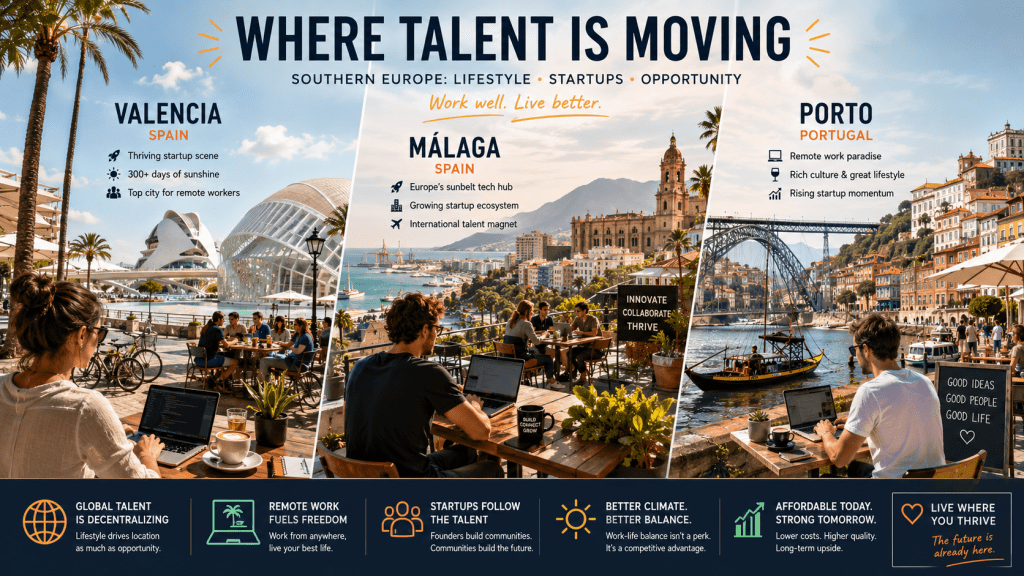
Cities like Valencia, Málaga, and Porto are increasingly attracting remote workers, founders, freelancers, digital nomads, and international startups.
The appeal is obvious:
better climate, lower living costs, strong food culture, walkability, improving digital infrastructure, and a more balanced lifestyle.
Málaga in particular has evolved from a tourism-focused city into a serious “sunbelt tech hub,” while Valencia increasingly balances startup growth with one of Europe’s strongest lifestyle offerings.
Southern Europe’s advantage is no longer just tourism.
It is becoming talent attraction.
That shift could become increasingly important as younger professionals place greater emphasis on flexibility, climate, and overall quality of life.
The Baltic Startup Model
The Baltics continue to outperform relative to their size.
Vilnius and Tallinn have developed reputations as digital-first ecosystems with extremely high startup density.
Fintech, e-government systems, startup-friendly regulation, and founder-oriented environments have helped these cities build influence far beyond their population size.
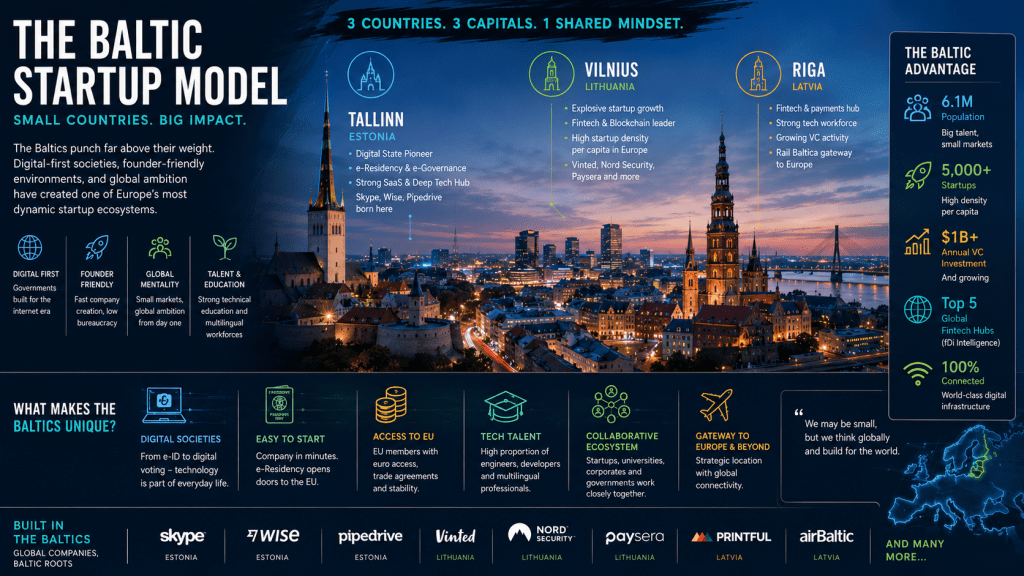
Tallinn’s “digital state” branding remains powerful, while Vilnius increasingly stands out for rapid startup growth, fintech momentum, and international ambition.
These cities demonstrate how smaller urban centers can compete globally through specialization, efficiency, and strong digital infrastructure.
Europe’s Boom Towns Are Different
What makes Europe’s boom towns interesting is that they rarely resemble the classic American model.
Many are centuries old.
Most are walkable.
They are built around universities, rail links, dense urban cores, culture, and quality of life rather than endless suburban expansion.
That may become their greatest advantage.
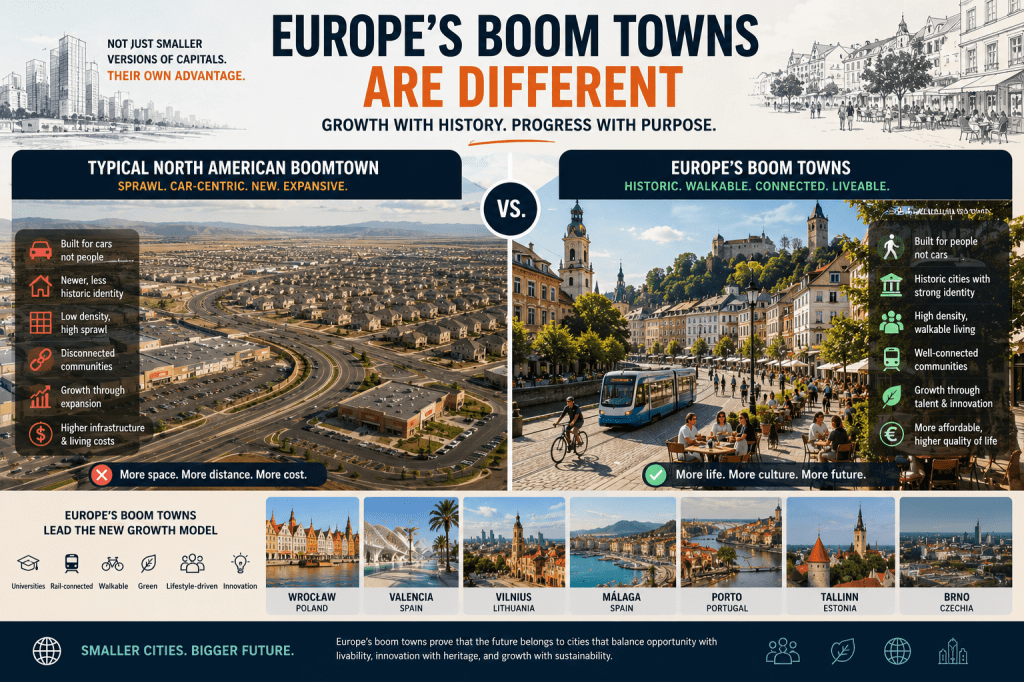
As remote work, demographic shifts, migration flows, and startup decentralization continue reshaping Europe, these secondary cities are no longer alternatives to the capitals.
They are becoming destinations in their own right.
And in the years ahead, Europe’s next major success stories may increasingly emerge not from the traditional giants — but from the cities quietly compounding beneath them.
Keywords: European boom towns, secondary cities Europe, Wrocław growth, Kraków startups, Gdańsk economy, Valencia startups, Málaga tech hub, Porto remote work, Vilnius fintech, Tallinn startup ecosystem, European migration trends, remote work Europe, digital nomad cities, European tech hubs, affordable European cities, startup ecosystems Europe, European economic growth, Baltic startups, Poland tech growth, Southern Europe growth, European livability, European real estate trends, European innovation hubs, European university cities, fintech Europe, European infrastructure, business services Poland, Europe remote workers, fast growing European cities, Europe 2026 trends
For readers interested in Europe’s growing gaming and digital entertainment economy, platforms like Evojacks.com are also expanding access to international lottery markets. Players can participate in global lottery betting — including Polish Lotto draws — alongside EuroJackpot, Powerball, and other major jackpots through crypto-powered infrastructure and the $EJX ecosystem.