Is Bitcoin a CIA Operation? Why the Claim Falls Apart Under Scrutiny
A recent viral clip featuring Jiang Xueqin, known online as “Professor Jiang,” has reignited an old conspiracy: that Bitcoin is secretly a CIA operation. The argument leans on game theory, Satoshi Nakamoto’s anonymity, and the idea that Bitcoin somehow benefits U.S. strategic interests. It’s provocative—but ultimately unsupported.

At its core, this claim reflects speculation rather than evidence.
Jiang Xueqin is not a cryptographer, blockchain engineer, or intelligence expert. His background is in education, philosophy, and historical analysis. While his “Predictive History” framework can be engaging, it often relies on pattern recognition and narrative-building rather than verifiable technical or empirical proof. That distinction matters when evaluating bold claims about a system as complex as Bitcoin.
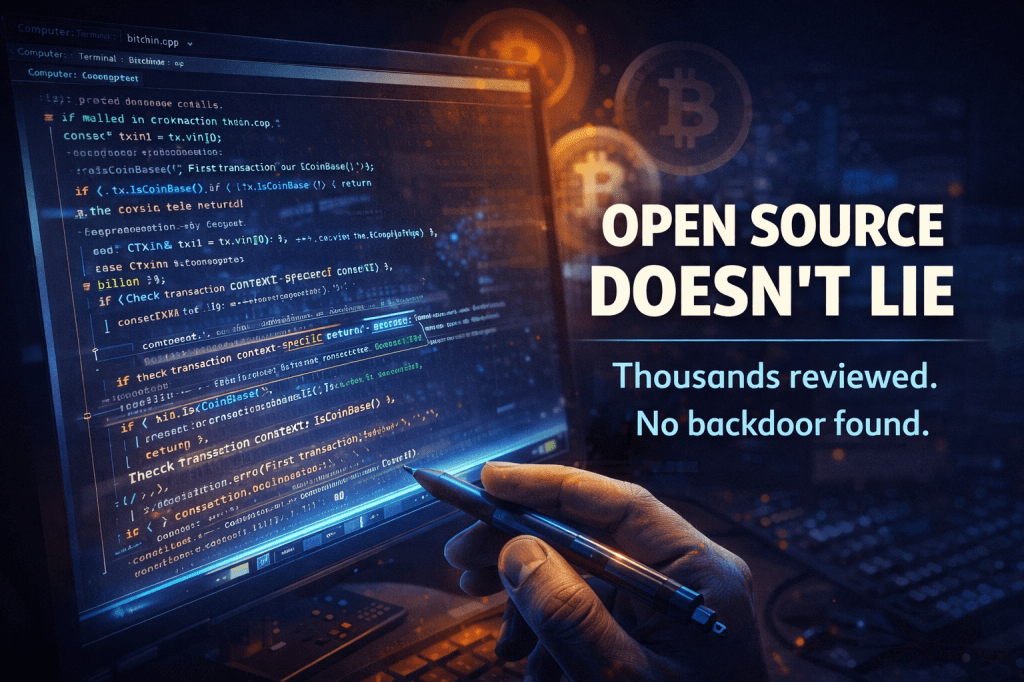
The central issue is simple: there is no credible evidence linking Bitcoin to the CIA, NSA, DARPA, or any government agency. Since its launch in 2009, Bitcoin’s whitepaper, codebase, and development history have been studied extensively by thousands of developers, researchers, and institutions. Over more than 15 years, no backdoors, control mechanisms, or hidden levers tied to any intelligence agency have been discovered.
Bitcoin is open-source. Anyone can inspect the code. Anyone can run a node. Anyone can fork the protocol. This level of transparency makes it one of the least likely systems to function as a covert government tool. If it were designed as a CIA operation, releasing it as fully auditable software would be an unusually ineffective strategy for maintaining control.
Jiang’s argument also misunderstands how Bitcoin infrastructure works. He questions the “physical location of blockchain servers,” implying centralized control. In reality, Bitcoin has no central server. It operates through a decentralized network of nodes distributed globally. Tens of thousands of independent computers validate transactions and maintain copies of the blockchain across dozens of countries.
This decentralized architecture is reinforced by proof-of-work mining, where participants compete to secure the network. No single entity can unilaterally alter the ledger or dictate the rules without broad consensus. This is precisely what makes Bitcoin resilient—and fundamentally incompatible with the idea of centralized control.
The surveillance argument is also weak. While Bitcoin transactions are public, this transparency actually limits its usefulness for covert operations. Intelligence agencies prefer systems that obscure activity, not expose it. Blockchain analysis tools used today are focused on tracking activity after the fact, not controlling the network itself.
It’s also worth considering Satoshi Nakamoto’s own writings. Early forum posts and emails suggest a clear distrust of centralized institutions, especially following the 2008 financial crisis. Bitcoin was explicitly designed as a peer-to-peer alternative to traditional finance—not an extension of it.

Ultimately, claims like this gain traction because they combine mystery with geopolitical intrigue. But without evidence, they remain what they are: speculation designed to capture attention.
Bitcoin’s strength lies in its transparency, decentralization, and global participation. These are not characteristics of a controlled system—they are the exact opposite.
As always in crypto, bold claims require strong proof. In this case, that proof simply doesn’t exist.
SEO Keywords:
Bitcoin, CIA Bitcoin theory, Satoshi Nakamoto, Bitcoin conspiracy, blockchain decentralization, crypto myths, Bitcoin facts, proof of work, Bitcoin nodes, open source crypto, decentralized network, blockchain transparency, crypto security, Bitcoin whitepaper, Satoshi identity, crypto regulation, blockchain technology, Bitcoin mining, global nodes, crypto adoption, digital currency, peer to peer finance, Bitcoin analysis, crypto debate, blockchain servers myth, Bitcoin infrastructure, crypto community, financial sovereignty, decentralized finance, Bitcoin network, crypto narratives, blockchain truth, Bitcoin explained
- Evojacks OriginalsEvojacks Originals: The Million-Dollar Expansion of Crypto Gambling The online casino industry is full of copy-paste platforms. Same games. Same layouts. Same recycled experiences with different logos slapped on top. Evojacks Originals is trying to go in the opposite direction. Instead of licensing generic casino content, Evojacks.com has now launched 33 fully in-house built Originals… Read more: Evojacks Originals
- Crypto gamblingEvojacks.com is rapidly becoming one of the most talked-about platforms in crypto gambling — not because of empty promises, but because the wins keep coming. Over the past weeks alone, the platform’s live win feed has showcased a relentless stream of payouts across multiple games. Mr Stephen hit an incredible streak with $4,000 won on… Read more: Crypto gambling
- Europe’s Boom TownsEurope’s Boom Towns: The Secondary Cities Quietly Winning 2025–2026 For years, Europe’s biggest capitals dominated attention. London, Paris, Berlin, and Amsterdam absorbed talent, startups, and investment while smaller cities played supporting roles. That balance is starting to shift. Across Europe, a new generation of “boom towns” is emerging — cities combining affordability, livability, startup growth,… Read more: Europe’s Boom Towns
- Evojacks Lotto BettingEvojacks Lotto Betting & Syndicates: Global Jackpots, Smarter Entry Evojacks is turning global lottery betting into a faster, more accessible, and more strategic experience. Instead of standing in line or relying on local access, players can tap into 27+ of the world’s biggest lotteries directly — all from one platform, with the same rules, the… Read more: Evojacks Lotto Betting
- A Million-Dollar WebsiteEvojacks: The Million-Dollar Website Redefining Crypto Gaming Evojacks is positioning itself as more than just another crypto casino. It’s building a new category around speed, transparency, and life-changing outcomes — anchored by one simple idea: every player should have access to million-dollar opportunities at any time. At the center of this vision is the Instant… Read more: A Million-Dollar Website


